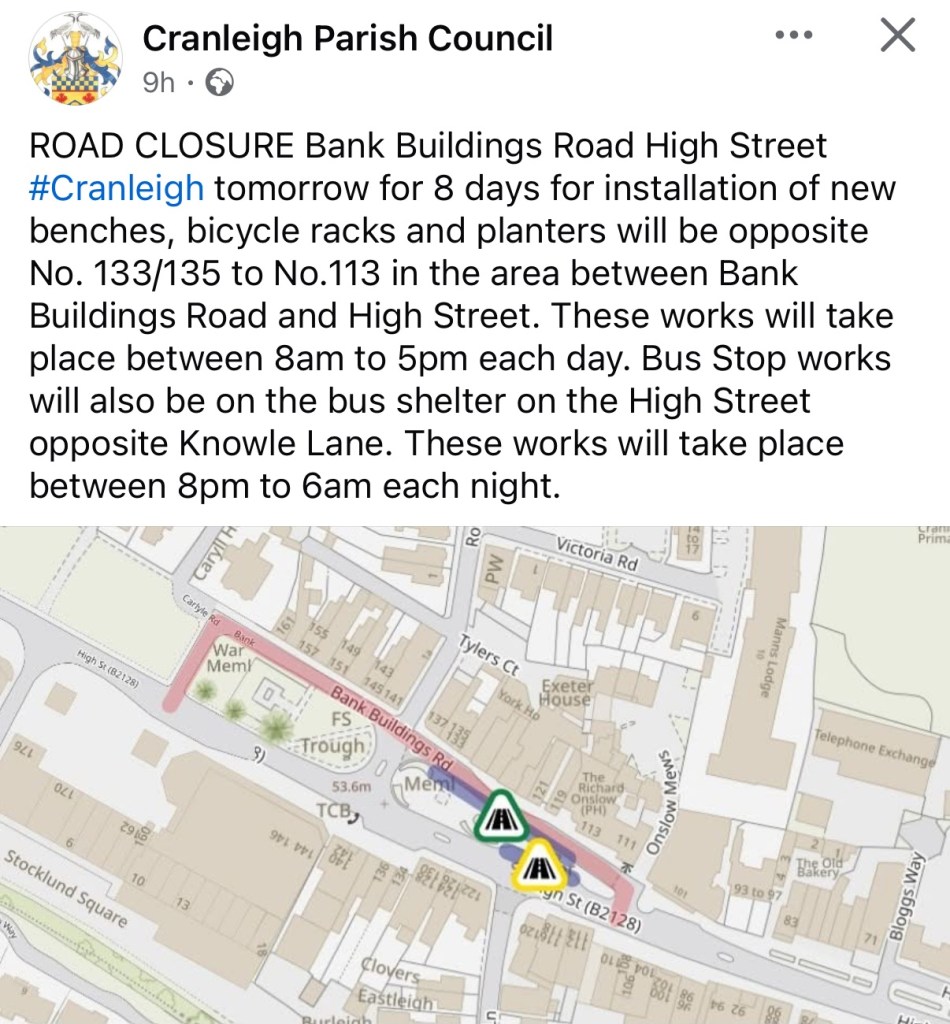
Cranleigh’s High Street is about to get a facelift or, at least, that’s the promise. Big changes are coming: planters, seating, bike racks, raised crossings, pavement widening — all wrapped in road closures, disruption, and questions about who’s paying and who’s really going to look after it. As with many well-intentioned local improvement plans, the enthusiasm for transformation is being met with a few well-founded doses of scepticism.
What’s Actually Being Funded — and by Whom?
First, let’s talk money. These improvements are being led by Surrey County Council (SCC), working in partnership with Cranleigh Parish Council and Waverley Borough Council.
A significant chunk of the funding comes from developer contributions specifically Section 106 agreements and the Community Infrastructure Levy (CIL).
According to the Cranleigh Chamber of Commerce, this is a “one-off opportunity… to improve the High Street” so local businesses can thrive.
Local councillors from the Liberal Democrats have emphasised that part of the aim is to make the High Street safer, greener, and more pedestrian-friendly, encouraging people to stay longer and support independent shops.
But will it actually help the High Street or just cause more headaches?
Here’s where things get a little thorny.
Road Closures & Disruption
There are planned road closures notably around the Post Office service road / Bank Buildings Road to install the new features.
The Cranleigh Society has been tracking progress, and their updates make it clear that while the goals are laudable, the delivery is complex, and the disruption is real.
For local businesses, road closures spell risk: loss of passing trade, delivery challenges, and general disruption. Some in the village already feel it’s too much, too often, and worry about whether the benefits will outweigh the inconvenience.
Planters, Seating & Maintenance: Who Will Keep It Tidy?
One of the most debated features is the installation of planters / rain gardens. According to Cranleigh Parish Council’s minutes, the design is still being finalised (“detailed design” phase) — and crucially, SCC admits it has no dedicated maintenance budget for the planters. Instead, they say they’ll “embrace volunteers.”
That raises a red flag. Cranleigh already relies on fantastic volunteers to maintain existing flower beds, and some residents wonder: are they expected to shoulder even more work now? Without ring-fenced funding for upkeep, there’s a real risk that these new planters could become overgrown, neglected, or simply rot.
Seating: More or Just More of the Same?
Another promised benefit is extra seating. On paper, more places to stop and chat sounds great. But as some locals have pointed out, Cranleigh already has “plenty of seating” much of which goes unused. Add to that the planned redevelopment of Stocklund Square, which will reportedly bring yet more seating (and another coffee shop), and you have to ask: are we solving a lack of seating or just adding more where it’s not needed?
Is it possible that the money might be better spent improving what’s already here, rather than piling on new benches and planters that may duplicate existing provision?
Is This the Best Use of Our Money?
Given that much of the funding comes from developer contributions, it’s fair to ask whether this is the best place for the cash. The Cranleigh Society has pointed out how tangled and opaque funding streams can be: many local residents don’t fully understand how S106 and CIL money is allocated, or why sometimes there’s limited transparency about how much is spent and where.
There are lingering concerns that £4 million (a figure cited in some local reporting) is being committed to a project that could have been more modest, more practical, or more directly targeted at long-term high street needs — such as:
Repairing existing pavements (which are reportedly in a poor state) Tackling flooding (raised crossings and rain gardens are part of the plan, but is it enough?) Addressing illegal parking and loading problems
So, Will It Improve the High Street, Really?
Yes, potentially. If done well, these changes could make Cranleigh High Street more pleasant, safer, greener, and more walkable. That could help footfall, support small businesses, and give residents more reason to linger rather than dash through.
But… the risk is very real that it becomes a well-meaning but half-maintained vanity project. Without long-term maintenance funding, the planters could look lovely at first — then deteriorate. Without genuine use, extra seating could be underused. And if disruption from roadworks scares off shoppers or causes logistical problems, local businesses might pay a price.
What Needs to Happen for This to Succeed
Clear long-term maintenance plan The council should commit to maintaining the planters, seating, and public realm features, rather than relying purely on volunteers. Transparent funding breakdowns Residents deserve to know exactly how much is being spent, where the money is coming from (S106, CIL, SCC’s capital), and how that aligns with local priorities. Ongoing community engagement The Parish Council has raised concerns about traffic flow, congestion, and air quality. These issues must be addressed, not glossed over. Monitoring and evaluation After installation, there needs to be a review: Are the features being used? Are planters maintained? Has footfall changed? If not, tweaks may be needed. Alternatives considered If seating is being added, can existing benches be refurbished instead of installing brand new ones? Could resources be better spent on resurfacing or local delivery logistics?
Cranfold Chronicle, along with countless long-standing residents, are asking a question that Waverley Borough Council has yet to answer convincingly: why hasn’t more been done to support independent high street businesses before now? Over the years, shop after shop has been forced to close its doors, squeezed by high rents, rising business rates, and dwindling footfall. The result is a village centre where true independent retail has all but vanished unless you’re after a coffee, a haircut, or something to eat. Against that backdrop, the idea that a scattering of planters, a few cycle stands, and some extra seats will somehow reverse a decade of decline feels wildly optimistic. What Cranleigh’s businesses needed was meaningful support long before things reached this point — not cosmetic tweaks delivered after most of the high street has already gone.
Cranleigh’s High Street improvement project is ambitious and, in many ways, heartening. It speaks to a desire to shift from a car-dominated, run-down main street to a green, people-centric hub. But ambition is not enough. For it to succeed, the scheme needs practical follow-through, not just pretty planters and “vision.”
If residents’ concerns aren’t taken seriously particularly about maintenance and realistic use there’s a real danger that these improvements could become underused, underfunded, or worse, resented.
 Cranfold Chronicle
Leave a comment